Jeffery Lyn Huckstead · Cerebral Graphix · research project
TnDex
TnDex reads a notebook record against the published papers. The record spans hand sheets, scrap notebooks and more than a thousand Desmos and screen captures. Each page has a code and belongs to one or more threads. Where the graph and the geometry agree exactly, the shape becomes an anchor. Every number that came with it is tried on its own, as structure, coincidence or convention.
Latest paper · 20 October 2026
Reading the Fold
A Global Newton Series for the Riemann Xi Function
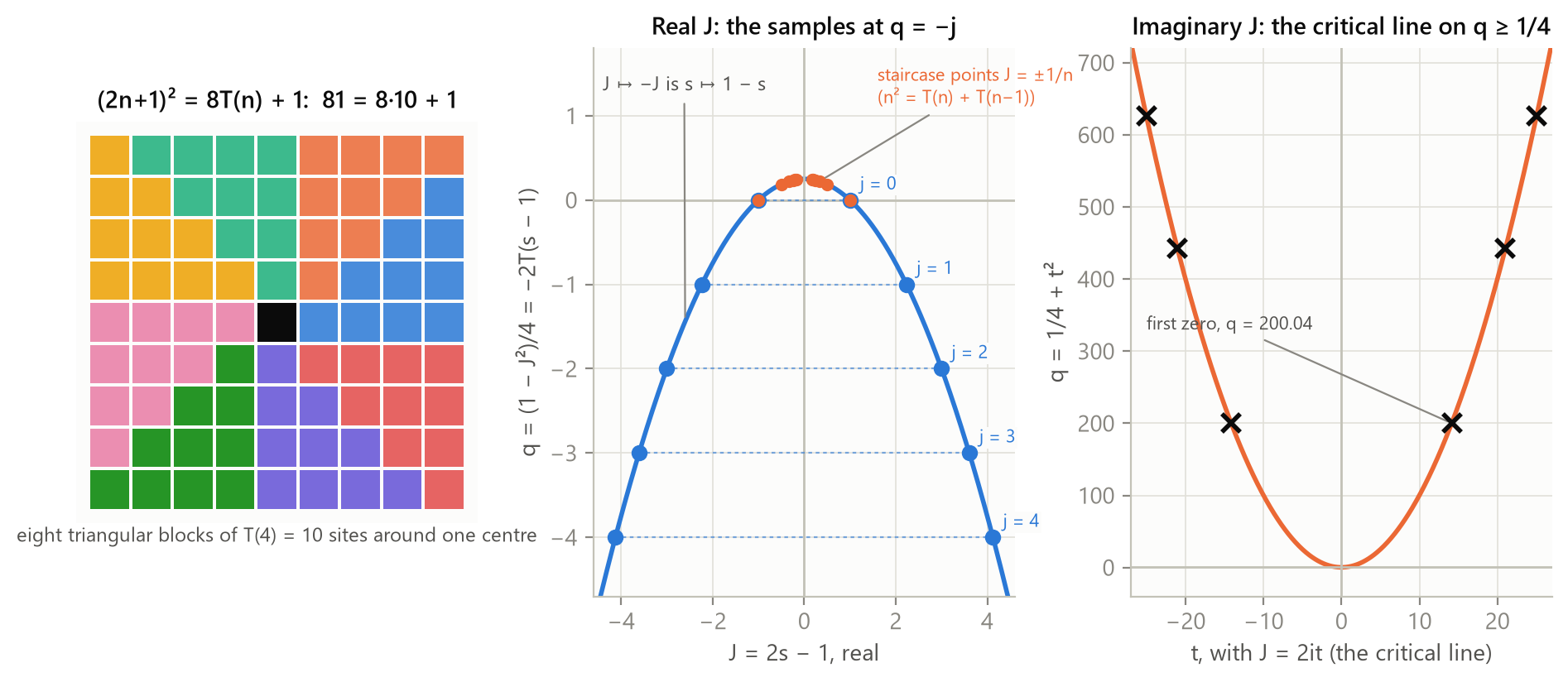
The coordinate q = s(1 − s) = −2T(s − 1) folds s and 1 − s into one point, so ξ becomes a single entire function X(q). Sample it at q = 0, −1, −2, …: every finite difference is positive. The Newton series in the simplex basis 1, q, T(q), … then converges on the whole plane, with a proved rational error for every finite version.
Shape Court
Six places where graph and geometry agree exactly, each one movable: the address triangle, the shadow of an equilateral, the fold and the bit, the staircase to ½, the 45° cone and π/√2, and eight triangles in the odd square. Below the cards, the docket gives a verdict on each number that came with them.
The paper's figures
The fold and its samples, the simplex shadow behind every coefficient, the error of the finite reconstruction along the critical line, and the entropy of the reciprocal-triangular law: 2.0462774528… nats, a sum over the even zeta values.
Built to come back to
Two earlier interactive pages start from the same triangular address. TnDex is where they meet.
C-Geometry · live paper
A triangularly addressed, scale-covariant plane geometry. It inherits the flattened triangular address of the TFG and connects reciprocal area, null coordinates, reciprocal metallic means and Pell-optimal cell grids. Its full congruence lock sits at c = √5 − 2.
The Polar Shell Renderer
Each reduced fraction k/n is placed at radius √n and angle 2πk/n. Every shell is an annulus of area π, and it carries φ(n) points. The fractions m/n that fill the address triangle in Shape Court sit here on shells, the reduced ones only.
How the index works
Verdicts on numbers: structure carried by a mechanism · coincidence no mechanism behind it · convention an artefact of a chosen convention · exact, unit-bound true, with meaning set by a unit or model · pending still waiting.
Twelve threads
Every page in the index sits on at least one thread.
Address and grid
Each integer i gets a chamber n = ⌊√(2i − ¾) + 3/2⌋ and a place m in it. Plotted as (−m/n, 1/n), the sites fill a right isosceles triangle.
Address triangle →Factorial and simplex
The rising-simplex polynomials 1, q, T(q), …, and the product Πn(y) = ∏(1 + jy), whose end coefficients are T(n) and n!, read at the half index n = −½.
Reading the Fold §3 →Reciprocals and decimals
Repeating decimals and digit-restricted sums: Midy's halves in 1/137, and the correction modes 1/91, 1/991, 1/9991 in sums with exactly n nines.
Reading the Fold §9.1 →Silver root 2, Pell and the cone
Pell branches, the silver ratio 1 + √2 and its rungs (7 + 5√2 among them), and the 45° cone that carries √2 into solid geometry.
C-Geometry live paper →Half shift and the fold
q = s(1 − s) = −2T(s − 1), and the staircase s = T(n)/n² climbing to ½, where the fold's two branches meet.
Staircase to ½ →Pi and the zeta ladder
Wallis's product read over the odd squares, and the even zeta values: ζ(10)/ζ(8) = (100/990)π², with 990 = 9·10·11 = T(44).
Odd squares →Primes and counting
Where primes enter the index: prime exponents on the notebook pages, the stop at 23, and the count of zeta zeros up to a height.
Docket →Converging on 2
The reciprocal triangular numbers sum to 2 because a triangle's vanishing edge cancels a pole. The simplex measures give d/(d − 1).
Reading the Fold §7 →Entropy and log 2
The law 1/(2T(n)) has entropy 2.0462774528… nats, a sum over even zeta values. A coin's entropy bends at the rate −1/q of the fold.
The fold and the bit →π/√2, the seed scalar
The sphere in a 45° cone of height π has radius π/√2. The shape law holds at every size; the early-2025 scalar is its value at H = π.
The cone →T(n)/n!
On the pink sheet, the ratio of successive denominators zips between exact forms set by the primes: (n + 2)/n when n + 1 is prime, 1/(2T(n)) when n + 2 is. T(2ᵏ − 1) is a perfect number exactly when 2ᵏ − 1 is prime.
Docket →The TFG and the Polar Shell Renderer
Reduced fractions k/n on shells of radius √n, each shell an annulus of area π holding φ(n) points; and the hexagonal coil of 6T(n) + 1 cells.
Polar Shell Renderer →Records
| record | DOI | threads |
|---|---|---|
| Reading the Fold, version 1.3 (20 Oct 2026) | 10.5281/zenodo.23511096 | T2, T5, T6, T8, T9 |
| Reading the Fold, earlier versions | 1.2 · 1.1 · 1 | on Zenodo |
| Volume I: Exact Geometry and Symbolic Foundations (19 Jun 2026) | 10.5281/zenodo.20768701 | T4, T10 |
| Triangular Addressing, Null Coordinates, and Reciprocal-Metallic Locks in a Scale-Covariant Plane Geometry (C-Geometry) | 10.5281/zenodo.21444929 | T1, T4 |
| The Polar Shell Renderer (9 Jul 2026) | 10.5281/zenodo.21280464 | T12 |
| The Hexagonal Coil (5 Jul 2026) | 10.5281/zenodo.21210741 | T12 |
| Divisor-Band Bijections and Totient Shells in the TFG (4 Jul 2026), with OEIS A394477 | 10.5281/zenodo.21187177 | T7, T12 |
| Triangular-n Postmaster, the main series | on the Postmaster page | all |