TnDex · paper
Reading the Fold
A Global Newton Series for the Riemann Xi Function
The fold
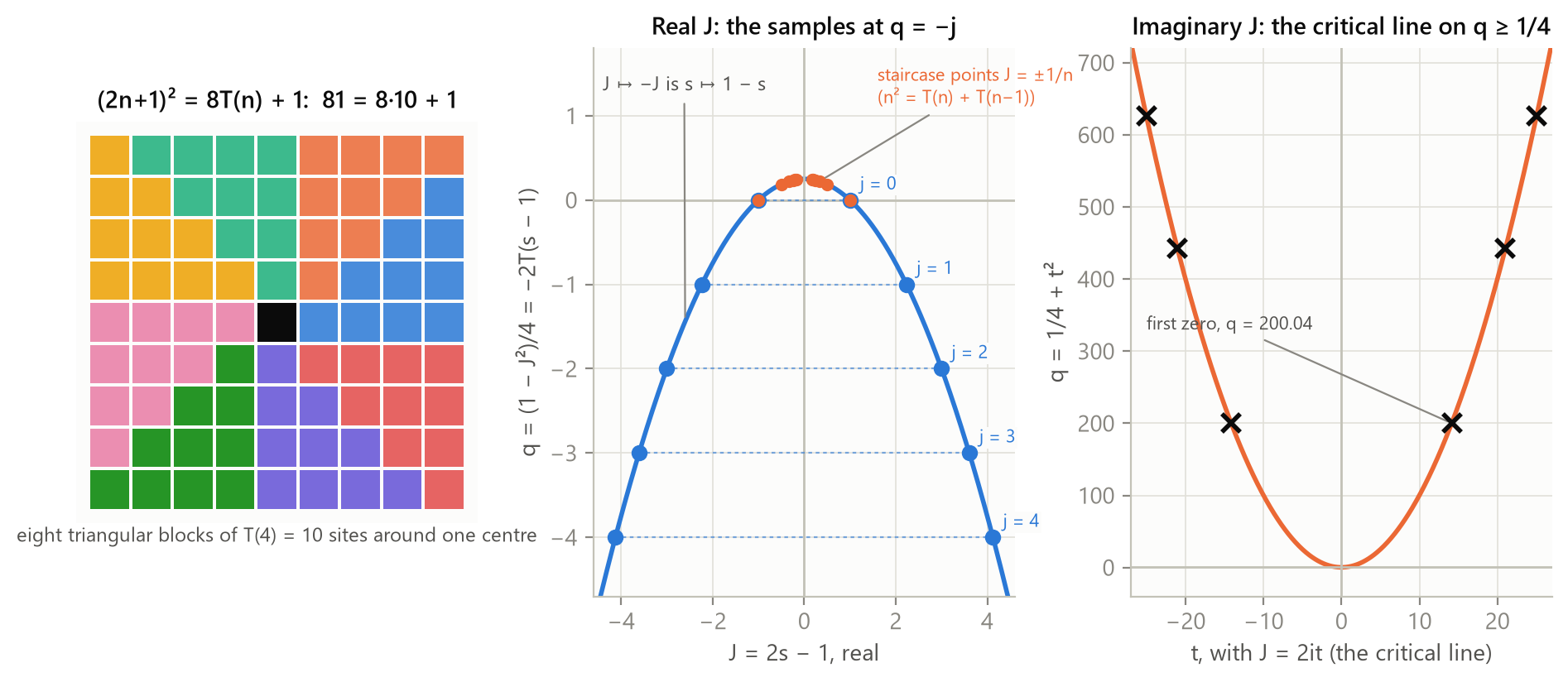
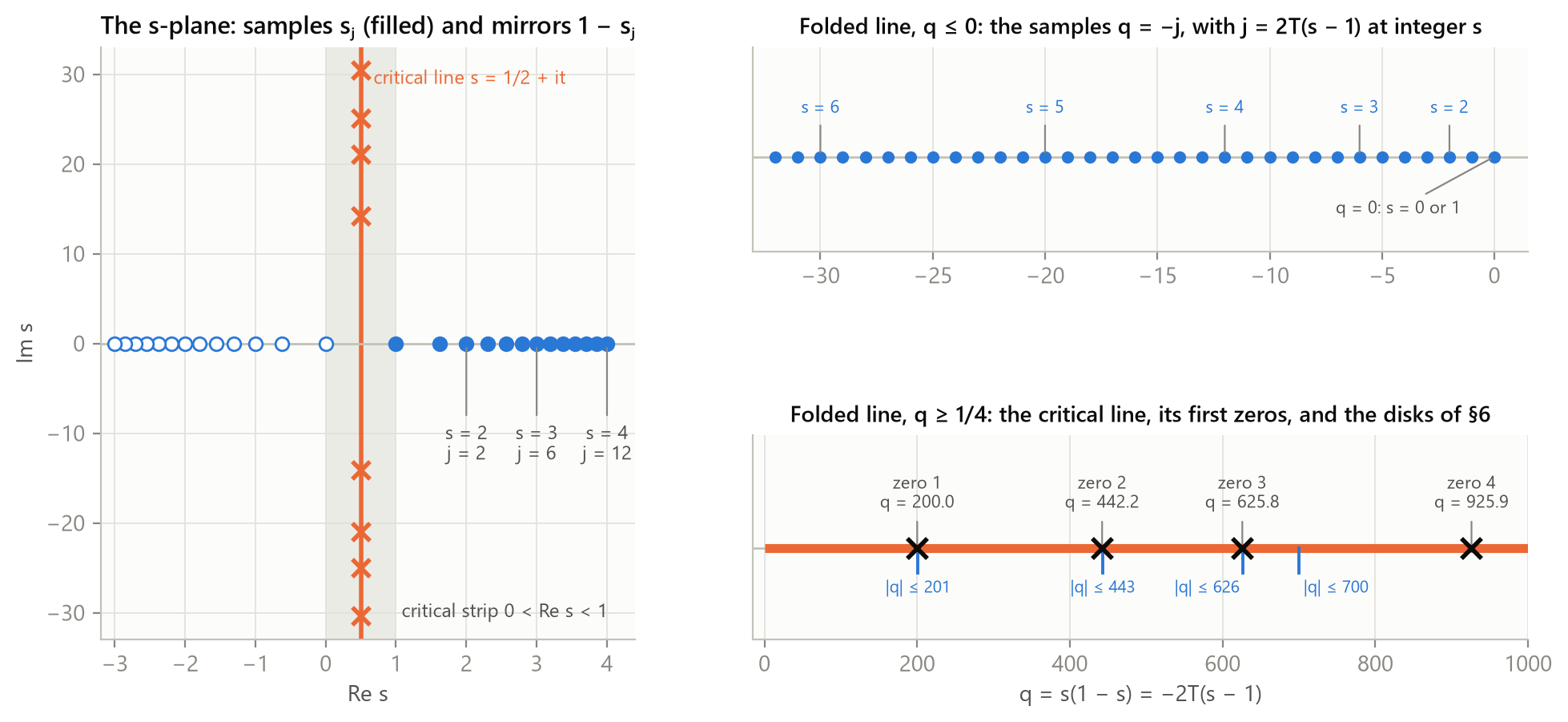
The Riemann zeta function hides its zeros behind a symmetry: the completed function ξ takes the same value at s and at 1 − s. The triangular coordinate q = s(1 − s) = −2T(s − 1) cannot tell the two apart, so ξ(s) = X(q) for a single entire function X. The critical line becomes the ray q ≥ ¼, and the real axis beyond s = 1 becomes the negative axis.
The fold is a parabola. Write J = 2s − 1. A square of side 2n + 1 splits into eight triangles of T(n) dots around one centre dot, (2n + 1)² = 8T(n) + 1. Put s − 1 in place of n and this becomes J² = 8T(s − 1) + 1, so q = (1 − J²)/4. Real J carries the real axis, where ξ is positive and easy to compute. Imaginary J carries the critical line, where q = ¼ + t². The two branches touch only at the vertex q = ¼.
The half index. The vertex is the half index s − 1 = −½, where the square's side is 0 and T(−½) = −1/8. The triangular product Πn(y) = (1 + y)(1 + 2y)⋯(1 + ny) has coefficients that are polynomials in n. Evaluated at −½ they give 1, −1/8, 1/128, 5/1024, …, the classical expansion behind the central binomial coefficients.
What the paper proves
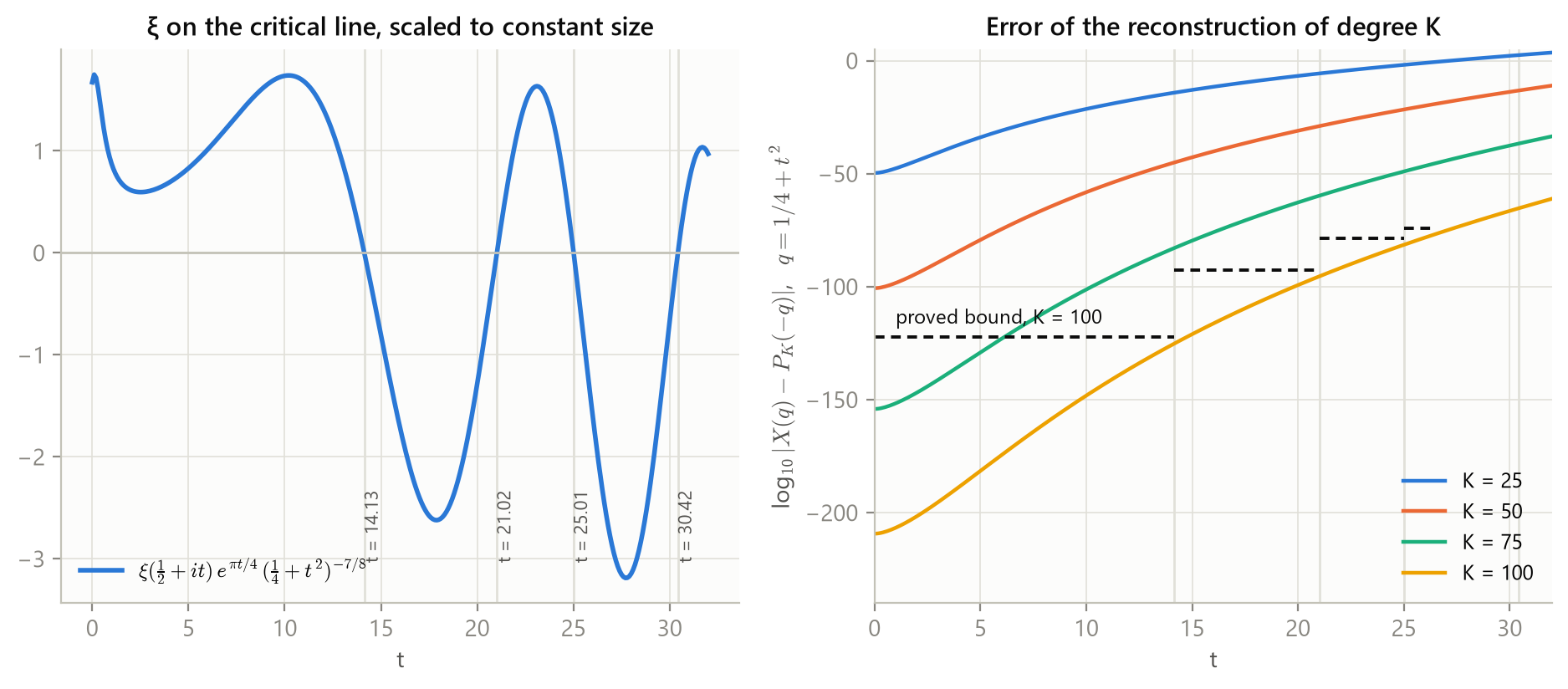
It rebuilds the whole function, including its values on the critical-line branch, from samples at q = 0, −1, −2, … (the value at q = 0 is exactly ½). The finite differences of those samples are the coefficients η₀, η₁, η₂, ….
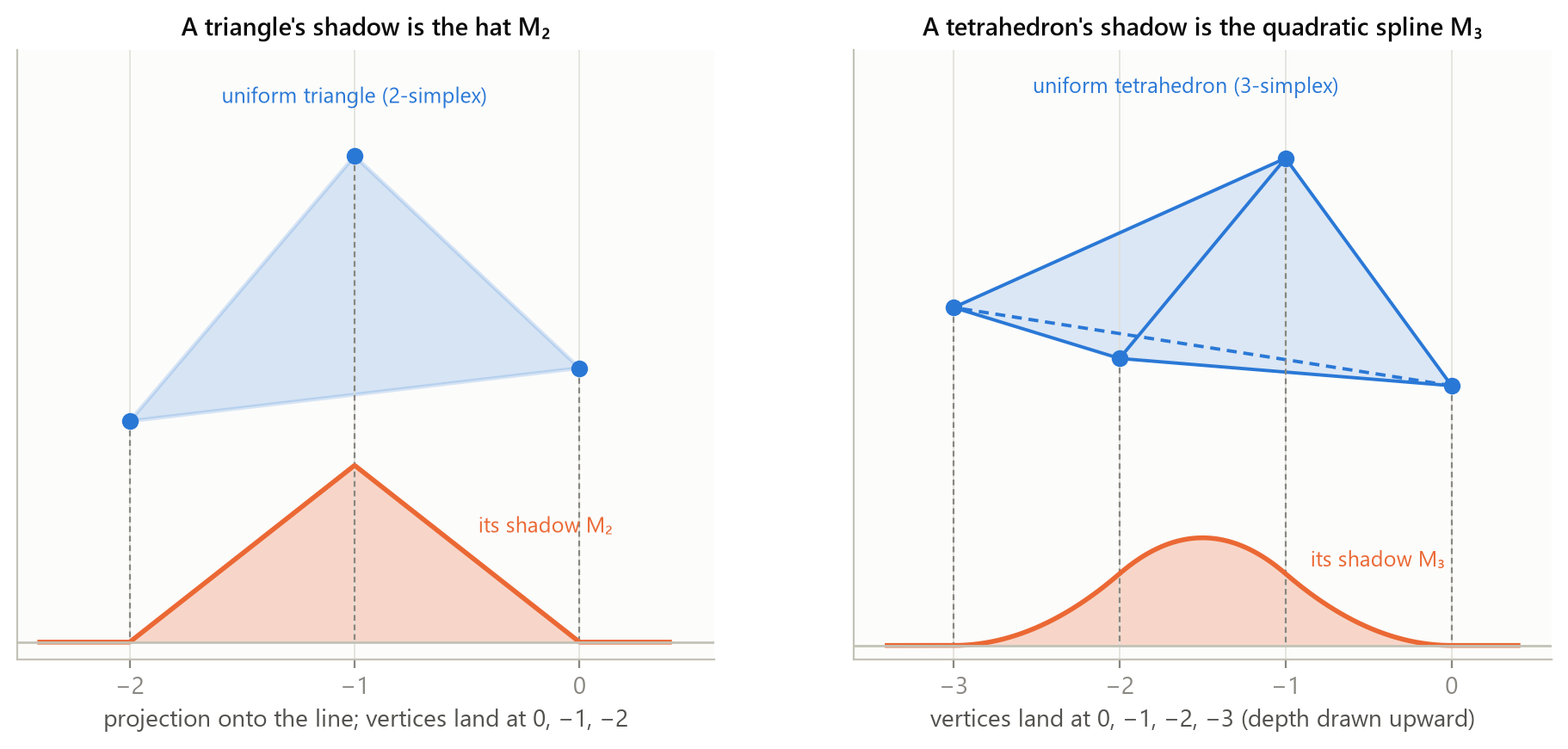
- Every coefficient is positive, at every order. Each one is an average of a positive derivative over the shadow of a simplex.
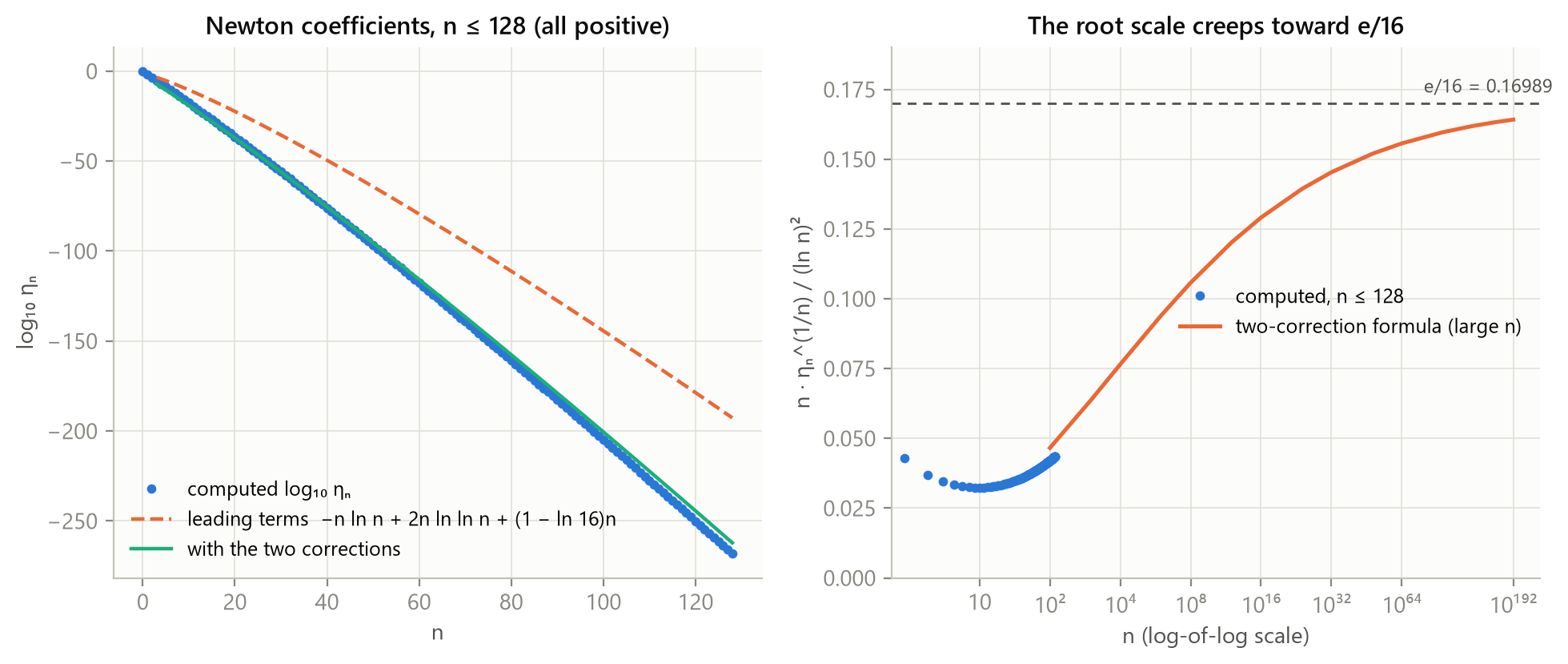
- The series converges everywhere. X(q) = Σ (−1)ⁿ ηₙ · q(q+1)⋯(q+n−1)/n! holds on the whole complex plane. Its basis is the ladder 1, q, T(q), …, so the triangular numbers appear twice: as the coordinate and as the building blocks.
- The coefficients fall at an exact rate: n·ηₙ^(1/n)/(ln n)² → e/16, and the next two corrections are determined.
- Every finite version has a proved error. With 101 coefficients the exact interpolating polynomial is within 10⁻¹²² of the function on a disk containing the first zeta zero. A polynomial with exact rational coefficients is certified to within 4.689 × 10⁻¹²³ there.
What it does not do. Positivity of the individual coefficients does not decide the Riemann hypothesis. That question is equivalent to a whole family of determinant inequalities. The paper states exactly where they sit, and gives small examples showing that these structural properties alone cannot force them.
Around the fold
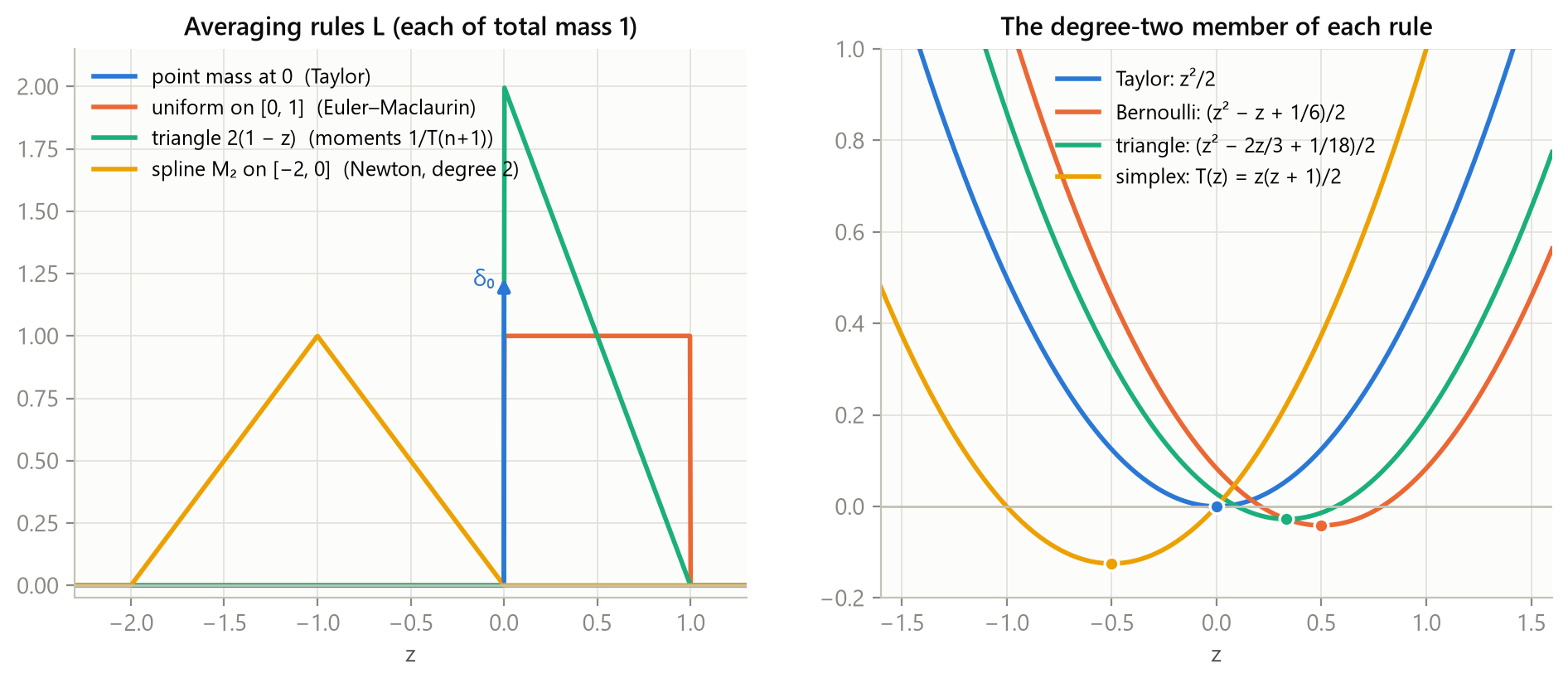
The averaging rule behind the series puts it in one family with Taylor's series, the Euler–Maclaurin formula and a triangular Bernoulli family. In that family the reciprocal triangular numbers sum to 2 because a triangle's edge cancels a pole. The same framework, developed by J.-F. Burnol, proves a pattern in digit-restricted harmonic sums: sums over integers with exactly n nines approach 10 ln 10, and for every n ≥ 1 the corrections come in powers of 1/91, 1/991, 1/9991.
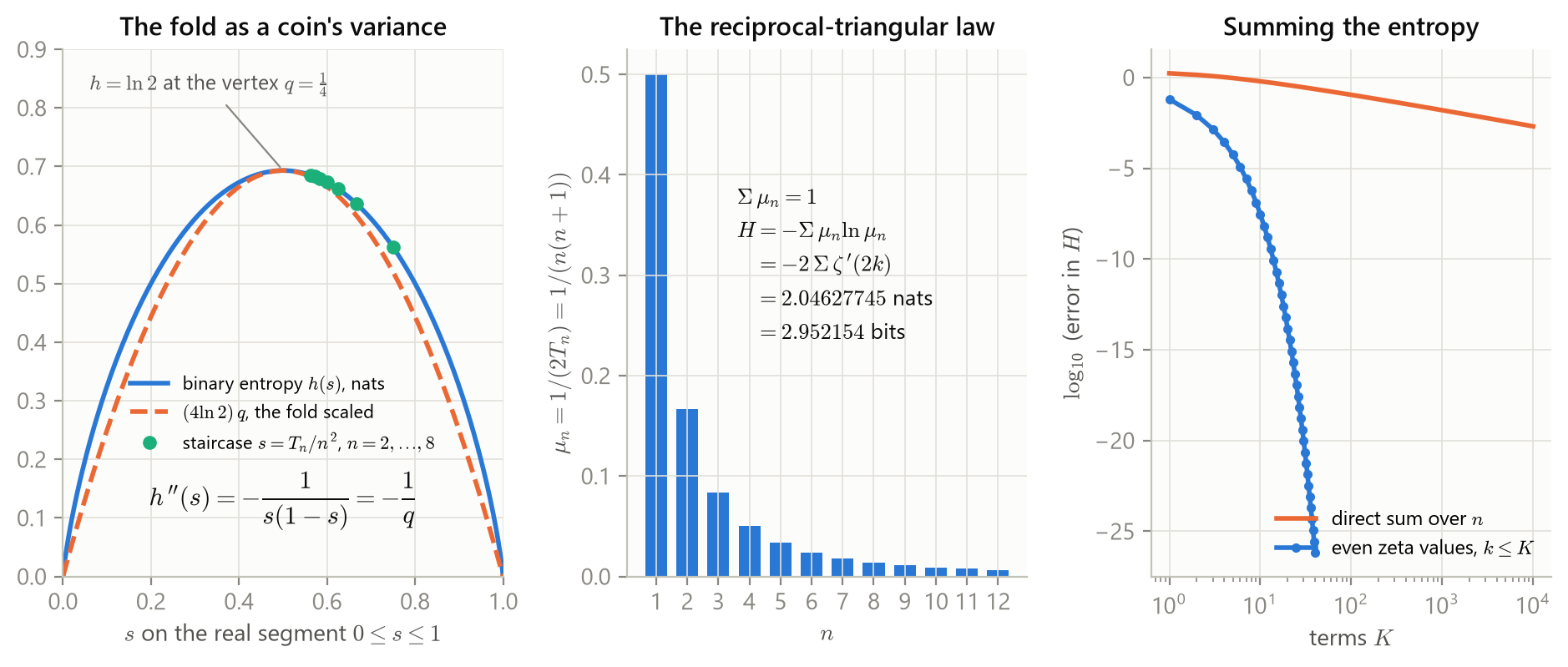
Entropy. Halve the reciprocal triangular numbers and they become probabilities, ½, ⅙, 1/12, …, summing to 1. Their entropy is 2.0462774528… nats, a sum over the even zeta values: −2Σζ′(2k) = ln 2 + 2Σ(ζ(2k) − 1)/(2k − 1). This is the classical entropy of the Lüroth map. On the real segment 0 < s < 1 the fold q = s(1 − s) is a coin's variance. The coin's entropy curves at the rate −1/q, and its maximum, ln 2, sits at the vertex q = ¼.
The 7/8. On the critical line, |ξ| is |ζ| times a completion factor. That factor's size is q^(7/8) times a decaying exponential: q¹ from the polynomial factor and q^(−1/8) from Gamma. The same 1 − 1/8 is the constant in the count of zeros up to height t.
100 over 990. Neighbouring even zeta values divide by Euler's formula. At one rung the ratio arrives, before any cancellation, as ζ(10)/ζ(8) = (2·5·π)²/(9·10·11) = (10π)²/990: the 2π of the formula, a 5 from each Bernoulli number, 9·10 from the factorials and 11 from the denominator of B10. That 990 is also the triangular number T44 is a rarer coincidence: among the products n(n + 1)(n + 2) with n < 2·10⁶, only six are triangular.
Figures
Several of these shapes can be moved by hand in Shape Court: the eight triangles, the staircase to ½, the fold and the bit, and the shadow of an equilateral.
Versions
| version | date | DOI |
|---|---|---|
| 1.3 (this page) | 20 October 2026 | 10.5281/zenodo.23511096 |
| 1.2 | 18 October 2026 | 10.5281/zenodo.23447547 |
| 1.1 | 18 October 2026 | 10.5281/zenodo.23443895 |
| 1 | 17 October 2026 | 10.5281/zenodo.23438542 |
Cite
@misc{huckstead2026fold,
  author    = {Huckstead, Jeffery},
  title     = {Reading the Fold: A Global Newton Series for the Riemann Xi Function},
  year      = {2026},
  version   = {1.3},
  publisher = {Zenodo},
  doi       = {10.5281/zenodo.23511096},
  url       = {https://doi.org/10.5281/zenodo.23511096}
}