Read here
Web reading route
A concise, phone-friendly path through the object, the eight parts and the exact research boundary.
Start the route ↓Volume I · Web reading route
From the triangular primitive to the completed source frontier.
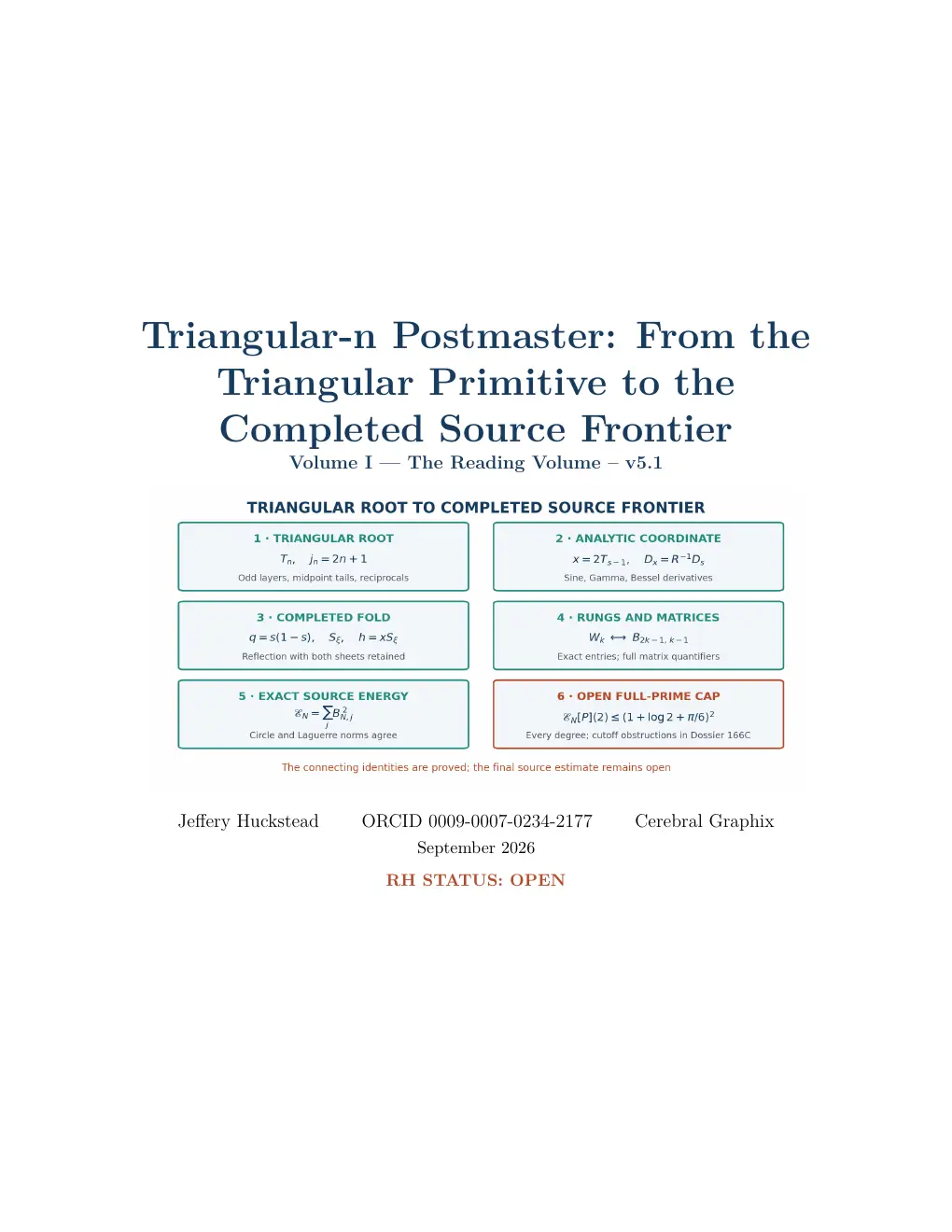
Begin with a familiar triangle, follow its reflection coordinate into the completed zeta source, and stop exactly where the proof stops. This page is the approachable layer; the Reading Volume and Technical Dossier remain one click deeper.
Choose the depth
The HTML route gives the shape of the argument. The Reading Volume carries the continuous mathematics. The Dossier carries the full proofs, certificates, countermodels and empirical context.
Read here
A concise, phone-friendly path through the object, the eight parts and the exact research boundary.
Start the route ↓Read continuously
101 pages, sections R1-R25. The argument, equations, figures, status key and final summary in one document.
Open the PDF ↗Peel in deep
281 pages of proofs, finite certificates, comparison models, failed shortcuts, source calculations and empirical context.
Open the Dossier ↗For source files, figures and verification receipts, download the complete v5.1 publication package: part 1 and part 2 (extract both into one directory).
Start here
Triangular numbers count familiar things: stacked objects, handshakes and the sum 1 + 2 + … + n. After centering the same primitive at its half-step, its reflection symmetry continues to the complex coordinate used by the volume.
The fold sends s and 1 − s to the same point. It does not silently merge conjugate points, and it does not assume RH. That distinction is one of the clarifications made explicit in v5.1.
The next step is a signed Pascal row. Each row gives an exact finite formula for one Widder rung. The full question is whether every rung is nonnegative at every positive scale. The phrase every rung is where the open problem lives.
Root to frontier
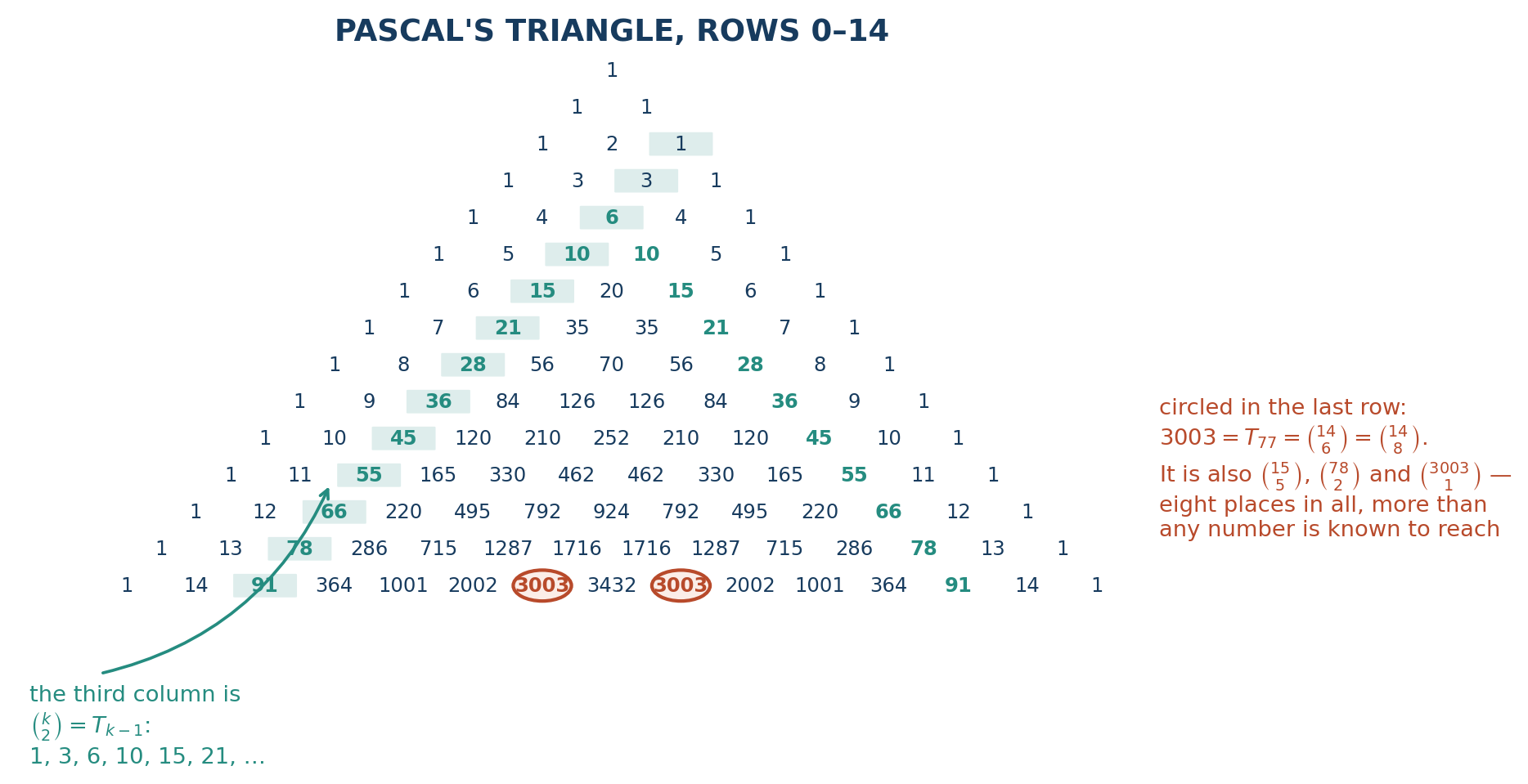
Each part stays readable at this level, then offers the exact Reading Volume page and a relevant Dossier entrance.
Build the discrete primitive, its reflection, reciprocal moments, the Euler-constant bridge and the half-step coordinate. This is the arithmetic root of the later analytic construction.
Carry forward: one centered coordinate can hold several exact identities without making those identities the same theorem.
Continue the centered triangular symmetry into q = s(1 − s). Reflection partners share a folded point; conjugation remains visible as a separate operation away from the critical line.
Carry forward: the fold removes the branch label, not the information needed to recognize critical-line membership.
The completed function is written in the folded coordinate, then organized as a resolvent, a heat trace and related positive representations. V5.1 states exactly how reflection pairs and multiplicity are counted.
Carry forward: positivity for a positive real folded node does not automatically extend to an individual nonreal kernel.
Every rung becomes one finite signed-Pascal row. The volume proves the first rung analytically, retains finite source certificates for the next five, and separates that route from the much longer verified-height prefix.
Carry forward: a finite prefix can be rigorous and enormous while still not supplying an all-order theorem.
The same folded data is read through Li coefficients, Löwner matrices, Gamma and prime blocks, Bernstein rows, Laguerre energy, cutoffs and exact-divisor residuals.
Carry forward: exact translations between forms do not make an unproved sign estimate disappear.
Here the volume isolates what an off-line point would leave behind: contour, heat and Green-function defects. These are exact detectors, but the source-side signs needed to close the argument remain separate.
Carry forward: detecting the shape of a failure is not the same as proving that no failure exists.
Results are restated with their quantifiers, then each surviving route is stopped at its first unsupported line. No unproved reduction between the matrix, energy, divisor and rung routes is assumed.
Carry forward: the next independent source rung is W7; the full criterion still requires every rung at every positive scale.
The no-go ledger records shortcuts already ruled out: finite-prefix stopping rules, coarse large-sieve closure, selected Gamma sublattices and other tempting replacements for the actual signed arithmetic remainder.
Carry forward: a failed shortcut narrows the corridor; it is neither evidence for RH nor evidence against it.
The final page of the argument
V5.1 ends by placing the coordinate, the proven finite results and the missing uniform source positivity in one summary.
What the fold preserves
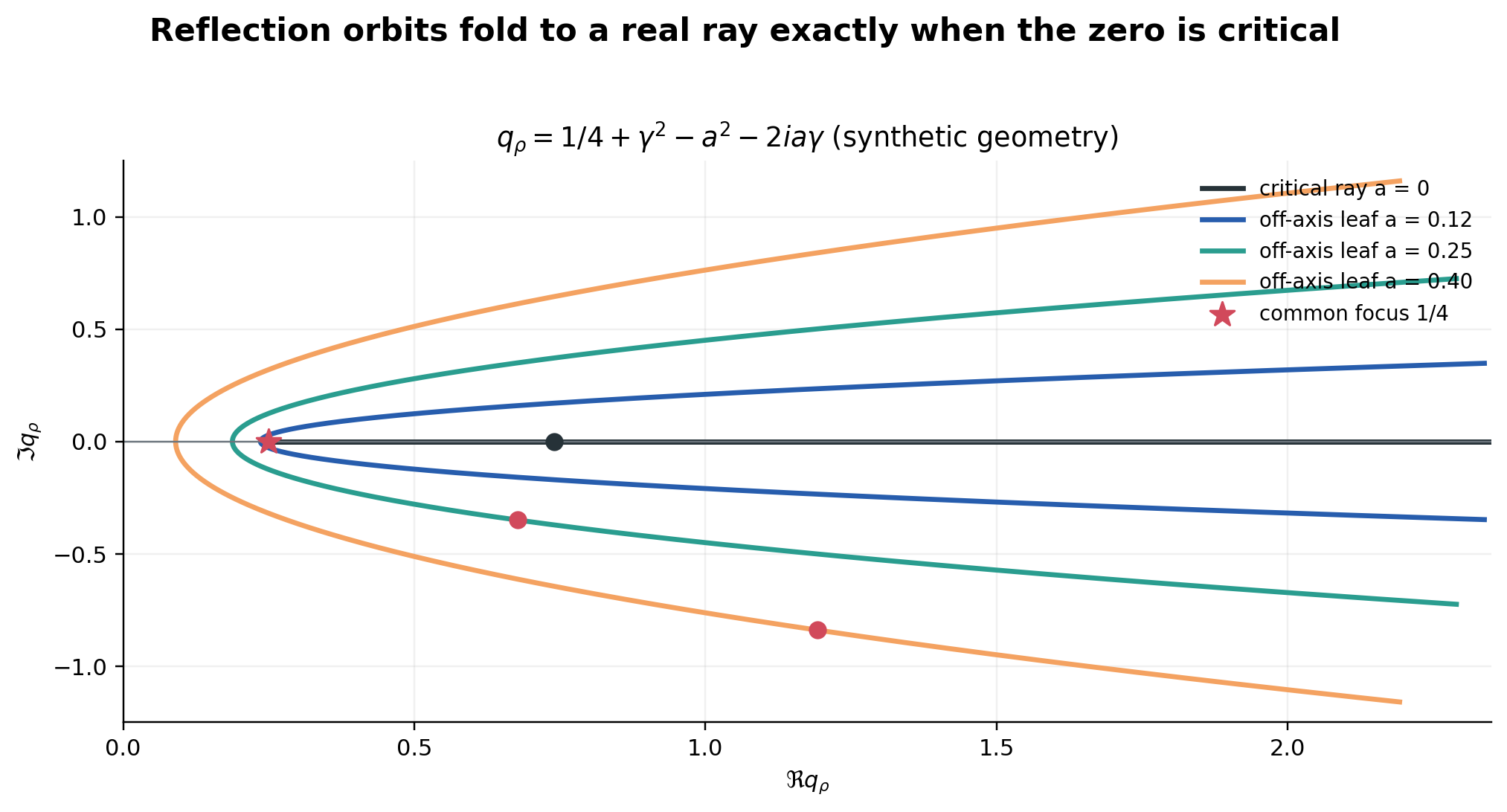
One reflection orbit {ρ, 1 − ρ} gives one folded node qρ. If a zero were off the critical line, its conjugate reflection orbit would give a second, conjugate folded node.
This is why v5.1 is careful about the index set and multiplicity before it sums anything. Reciprocal and sign changes of a nonzero folded coordinate are reversible; taking only a real part is a further observation and can lose information.
Where the work stands
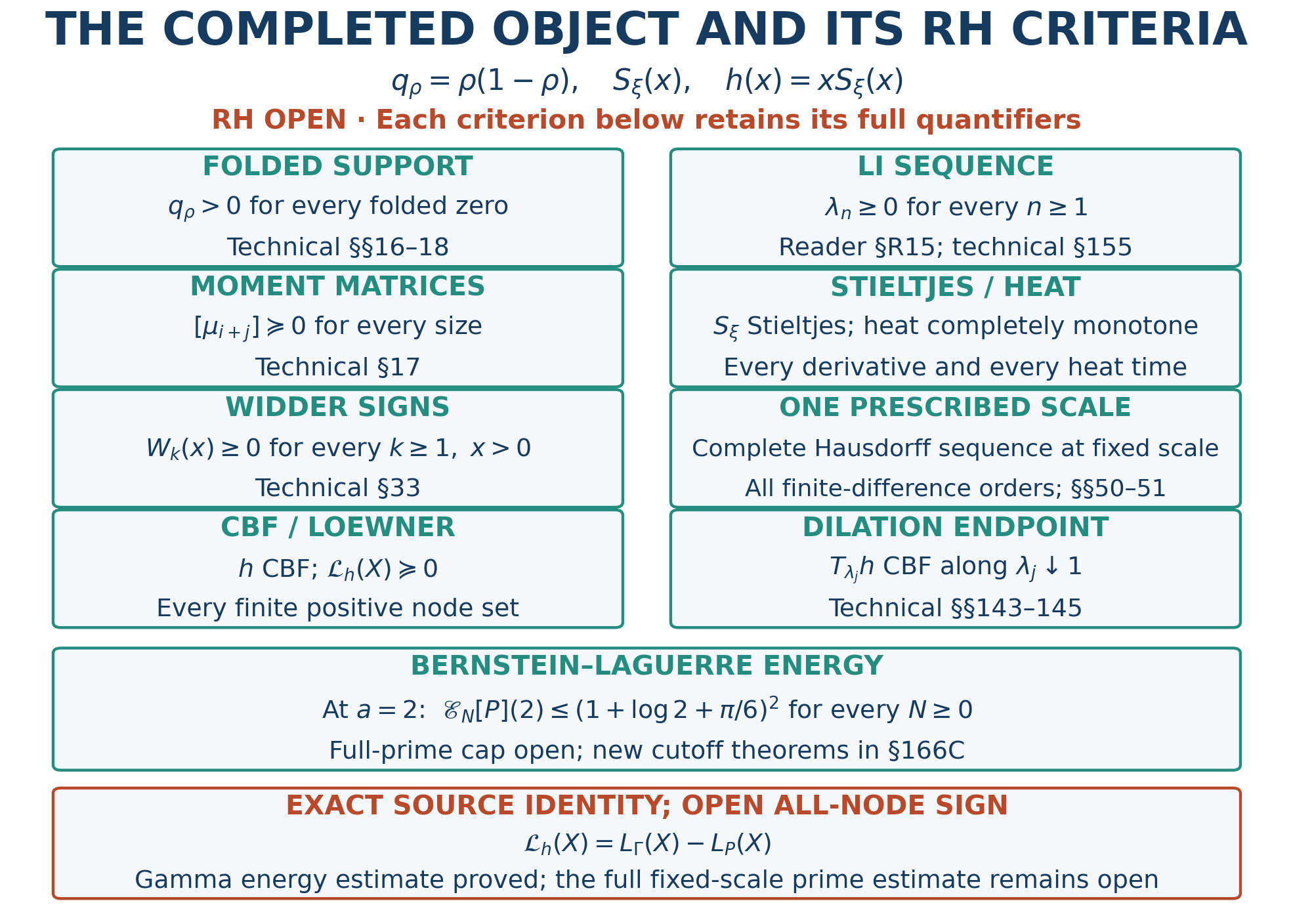
The boundary is mathematical, not rhetorical. Every result keeps the range and assumptions that make it true.
Established in the volume
Still open
Frozen website edition
V5.1 is an interface and exposition revision. It clarifies how the work is read without changing the inherited mathematical status.
The abstract and final summary now name the same folded object, proof channels and remaining obligations.
Reflection-pair indexing, multiplicity, conjugation and what the coordinate preserves are stated before downstream constructions use them.
Positivity and monotonicity of an individual resolvent kernel are restricted to a positive real folded node.
The v5.0 certificates are preserved as inherited evidence. V5.1 checks its interface and document build; it does not claim a new certificate run or a new RH implication.
Publication details
This site hosts v5.1 as an assembled manuscript/source edition. It does not yet have its own Zenodo deposit. The concept DOI below is the durable link for the version series; the files here are the frozen v5.1 edition.
Huckstead, Jeffery. Triangular-n Postmaster: From the Triangular Primitive to the Completed Source Frontier. Volume I - The Reading Volume, v5.1. Cerebral Graphix, September 2026.
Version series: 10.5281/zenodo.21968915.
ORCID: 0009-0007-0234-2177.