A message hidden as an address.
A fraction becomes a grid address. The address recovers an integer. A public convention turns the integer into text. Meaning stays with the receiver, where it belongs.
The bridge in five ledges.
The page is built to let a stranger climb from curiosity to verification without needing the paper first.
The plumbing ledger.
Accounting style. The left column posts one operation per line; its result crosses to the right column as that line's input, then drops to the next line. You can watch every value move — output becomes input, all the way down. Nothing is hidden in a single click.
- Reduce / readthe reduced fraction r/sr/s = 16862/65→r = 16862, s = 65The starting entry. Everything posts from here.
- Find chambern = ceil(r / s)ceil( 16862 / 65 )→n = 260The only chamber it could belong to.
- Membershipdoes s divide n?65 | 260 ?→yes → 260 = 4 × 65It belongs. A real step exists.
- Band remaindert = r − s(n−1)16862 − 65×259→t = 27Position in the chamber, in denominator ticks. Not the step yet.
- Apply scalek = (n / s) × t( 260 / 65 ) × 27 = 4 × 27→k = 108Scale is 4. The true step 108 is NOT the remainder 27. Stopping early breaks it.
- Public conventionASCII(k)ASCII 108→lOnly now does a convention make it a letter. The math gave the integer; ASCII gave the symbol; you supply the meaning.
Read top to bottom: the fraction became a chamber, a remainder, a scaled step, and only at the last line a letter. Each B value was the next A input. Stopping before the scale line would have posted the wrong number.
Want another? Read the paper for a known fraction, or make your own by pressing Flip direction — type a letter and watch its fraction build.
Driven backward: a symbol became a code, a chamber, a common factor, a denominator and numerator, and finally a fraction. Press Flip again to decode it and watch it return to the letter.
Off the grid. This fraction sits inside its chamber but never lands on a step, so there is no letter to read. That is not a bug — it is a known, pre-recorded outcome the ledger keeps an account for.
The remnant is what survives: the position the numerator reached inside the chamber, in denominator-sized ticks. It is a real value with no home on the grid. Read the paper for a fraction that lands, or press Flip direction to build one from a letter.
Live bridge lab.
Encode text into theorem-addressed fractions, then decode a payload back into integers and text. Everything runs locally in this file.
1. Encode a message
2. Decode a payload
Bridge output
Recovered text appears only after the integer layer is interpreted by a public convention.
| # | char | r/s | n | t | n/s | k | status |
|---|---|---|---|---|---|---|---|
| 1 | t | 65908/257 | 257 | 116 | 1 | 116 | ok |
| 2 | h | 33205/129 | 258 | 52 | 2 | 104 | ok |
| 3 | i | 9561/37 | 259 | 15 | 7 | 105 | ok |
| 4 | s | 13491/52 | 260 | 23 | 5 | 115 | ok |
| 5 | space | 67892/261 | 261 | 32 | 1 | 32 | ok |
| 6 | i | 68487/262 | 262 | 105 | 1 | 105 | ok |
| 7 | s | 69021/263 | 263 | 115 | 1 | 115 | ok |
| 8 | space | 8683/33 | 264 | 4 | 8 | 32 | ok |
| 9 | t | 70076/265 | 265 | 116 | 1 | 116 | ok |
| 10 | e | 70591/266 | 266 | 101 | 1 | 101 | ok |
| 11 | s | 71137/267 | 267 | 115 | 1 | 115 | ok |
| 12 | t | 17918/67 | 268 | 29 | 4 | 116 | ok |
The exact law, minus the fog.
This is the engine the lab uses. The important trap is that t is not the step unless n/s = 1.
Inside chamber n are n evenly spaced steps in the interval (n-1, n]. The address is the pair (n,k).
The theorem recovers an address. The convention layer recovers text. Those two jobs stay separate.
The canary row
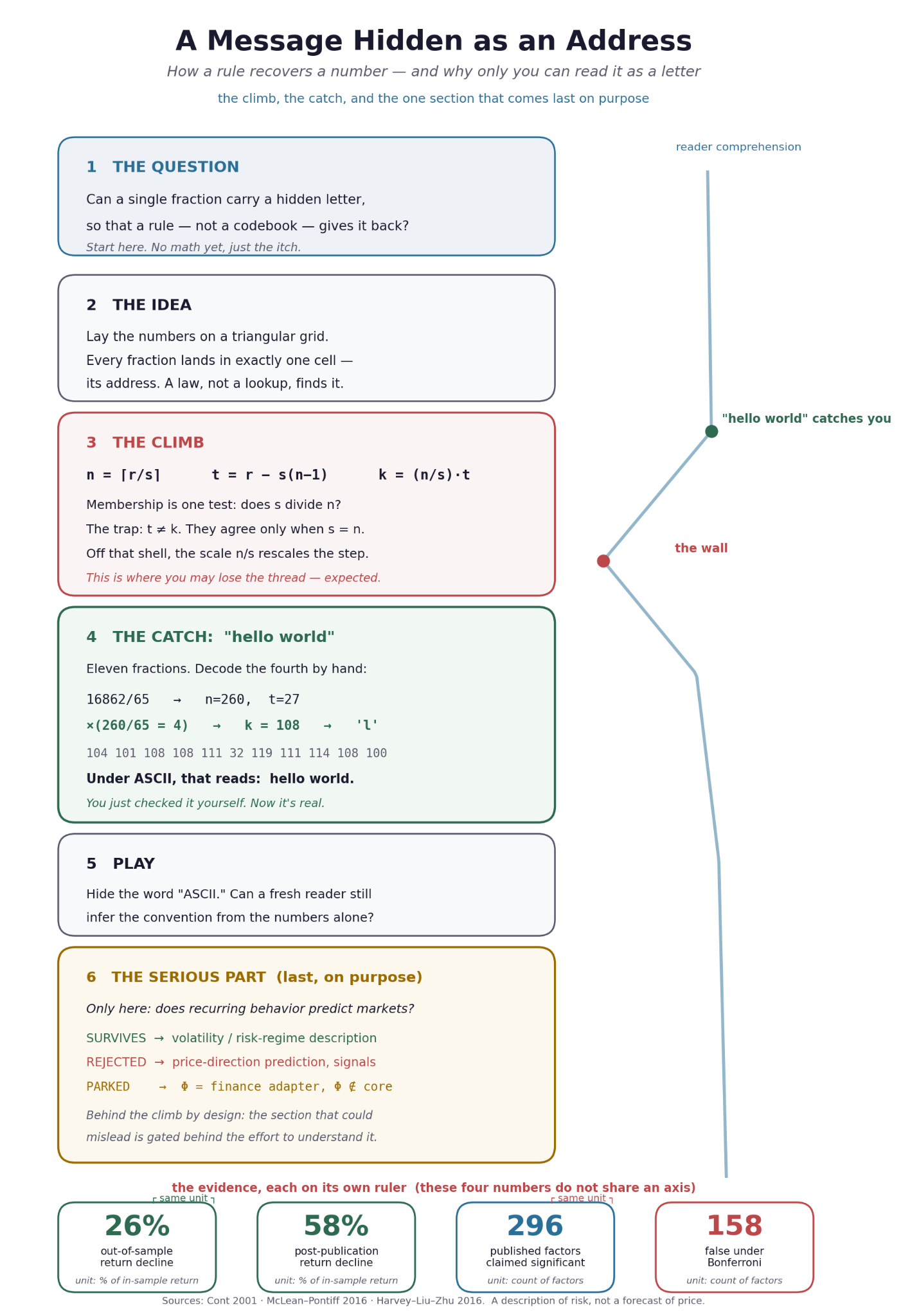
16862/65 lands in chamber 260. The band remainder is 27. Since 260/65 = 4, the true step is 108. Stopping at 27 breaks the message. Scaling to 108 recovers. One might try using a known good example such as listed in the thesis paper or even using that flip directons button to code your own example. l under ASCII.
The firewall is part of the bridge.
Clean structure is not the same as true interpretation. The page refuses the attractive wrong claims right where a reader might be tempted to make them.
What survives
- The grid law can recover a valid address exactly.
- Public conventions can map integers to text.
- Receivers can independently recognize shared ledgers.
- Volatility recurrence may describe risk regimes.
What gets refused
- No hidden proof of meaning.
- No claim that this is compression or secure encryption.
- No price-direction prediction or buy/sell signals.
- No predictive certainty from recurrence.
Future finance adapter terms
- Adapter: future FINANCE/MARKET adapter only.
- Scope: outside the core theorem-address layers.
- Process: source-locked data, versioned dashboards, and human review.
- Hard refusals: no trades, no signals, no predictive certainty.
Packet handoff.
The beta bridge can travel as one folder: this HTML file, the capstone PDF, and the ladder infographic.
Bridge contract
- One HTML file, no framework, no external fonts, no analytics.
- Works offline once the folder is downloaded.
- JavaScript is used only for the live lab.
- The PDF is the rigorous source. The page is the doorway.